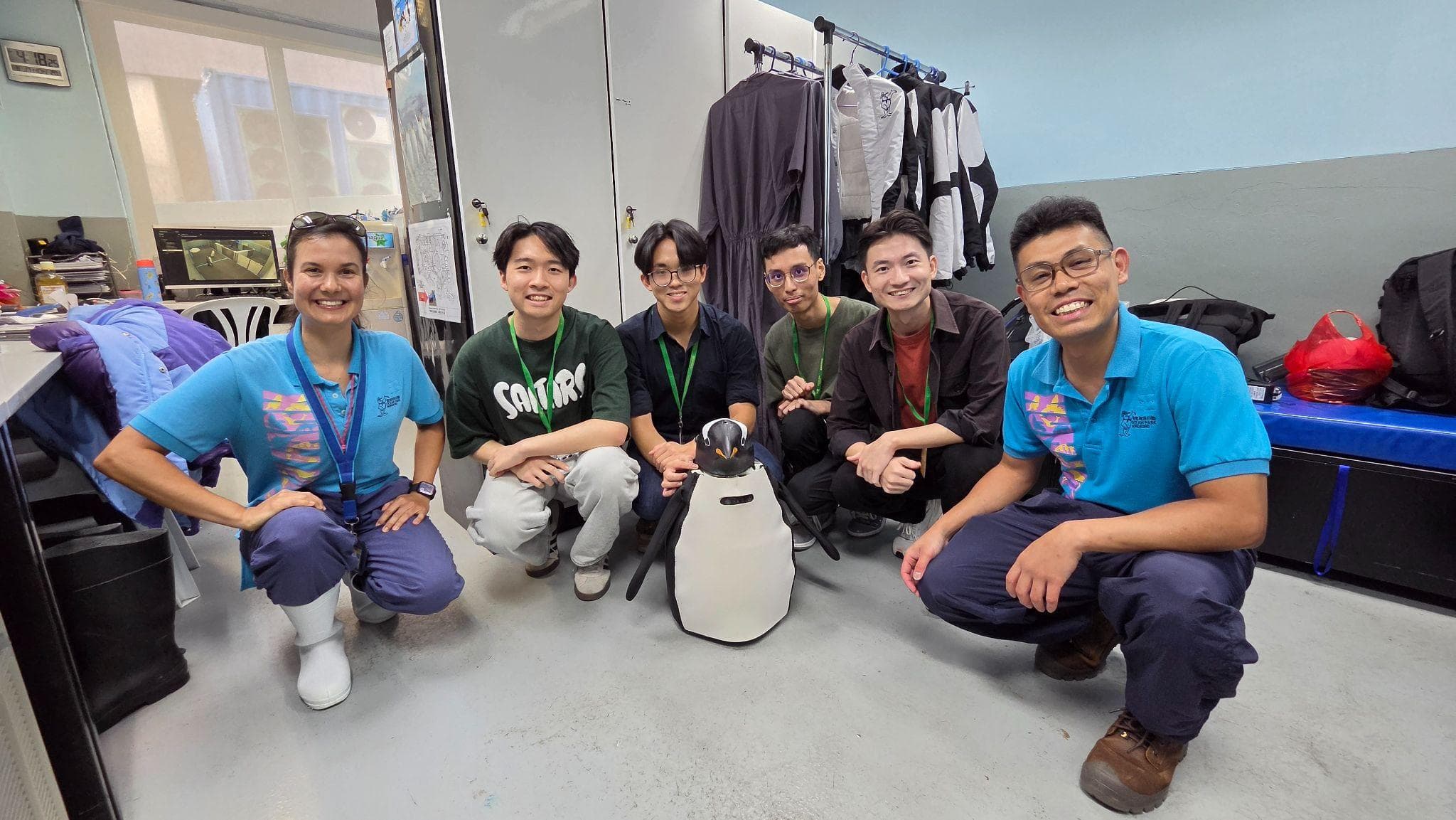
Testing PANGUAN at Ocean Park: A Step Toward Smarter Animal Care
A behind-the-scenes look at PANGUAN's first real-world site test, remote operation, animal-welfare goals, and the next iteration of the robotic platform.
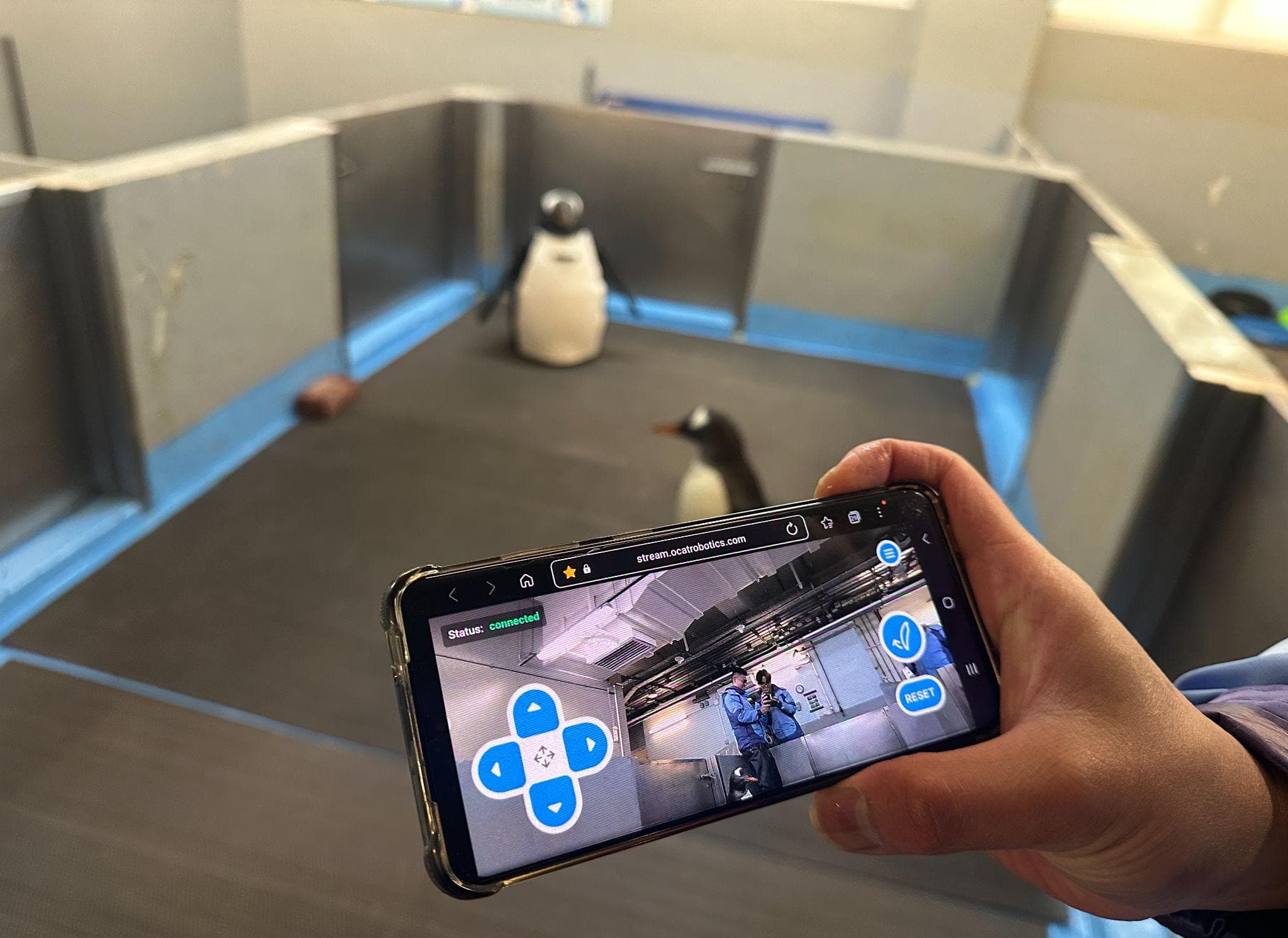
PANGUAN is being developed to explore how robotic remote presence can support animal care, monitoring, and potentially enrichment. Rather than requiring staff to enter an enclosure for every observation, a remotely operated robotic platform could provide another way to observe animals and collect information from within their environment.
Our recent visit to Ocean Park gave us an opportunity to test this idea in a real penguin-care environment for the first time. Before the visit, our team focused heavily on making PANGUAN functional, durable, and robust enough to handle the demands of an animal-care environment.
Here is a behind-the-scenes look at how the site test went, what features we put to the test, and how remote technology could support future animal care and monitoring.
How PANGUAN Could Support Animal Welfare
We built PANGUAN with three main objectives: supporting penguins during isolation, assisting caretaking through potential AI implementations, and exploring animal responses to robotic companions.
Providing Companionship for Temporarily Isolated Penguins
When a penguin needs to be separated from its group for medical care, rehabilitation, or other animal-care reasons, it may have fewer opportunities for normal social interaction. We are exploring whether a penguin-shaped robotic platform could provide a form of remote social presence or enrichment during these periods.
AI-Assisted Monitoring for Animal Welfare
PANGUAN could eventually use onboard cameras and AI to help caretakers identify potentially important events, such as damaged eggs, aggressive interactions, or an infant penguin falling into the water. Rather than replacing animal-care specialists, the system would serve as an additional monitoring layer to help bring potential incidents to their attention.
Understanding Animal-Robot Interactions
PANGUAN also provides an opportunity to study how penguins perceive and respond to robotic systems. The observations from this field test, including the penguins' initial cautious responses, can help us refine the robot's appearance, movement, and behaviour to make future interactions less disruptive and potentially more beneficial to the animals.
Ocean Park provides an important real-world environment for evaluating PANGUAN and exploring whether it can ultimately deliver meaningful benefits for animal care and welfare.
Designed With Penguin Safety in Mind
Animal safety is one of the key design considerations, and PANGUAN incorporates several features intended to reduce risk.
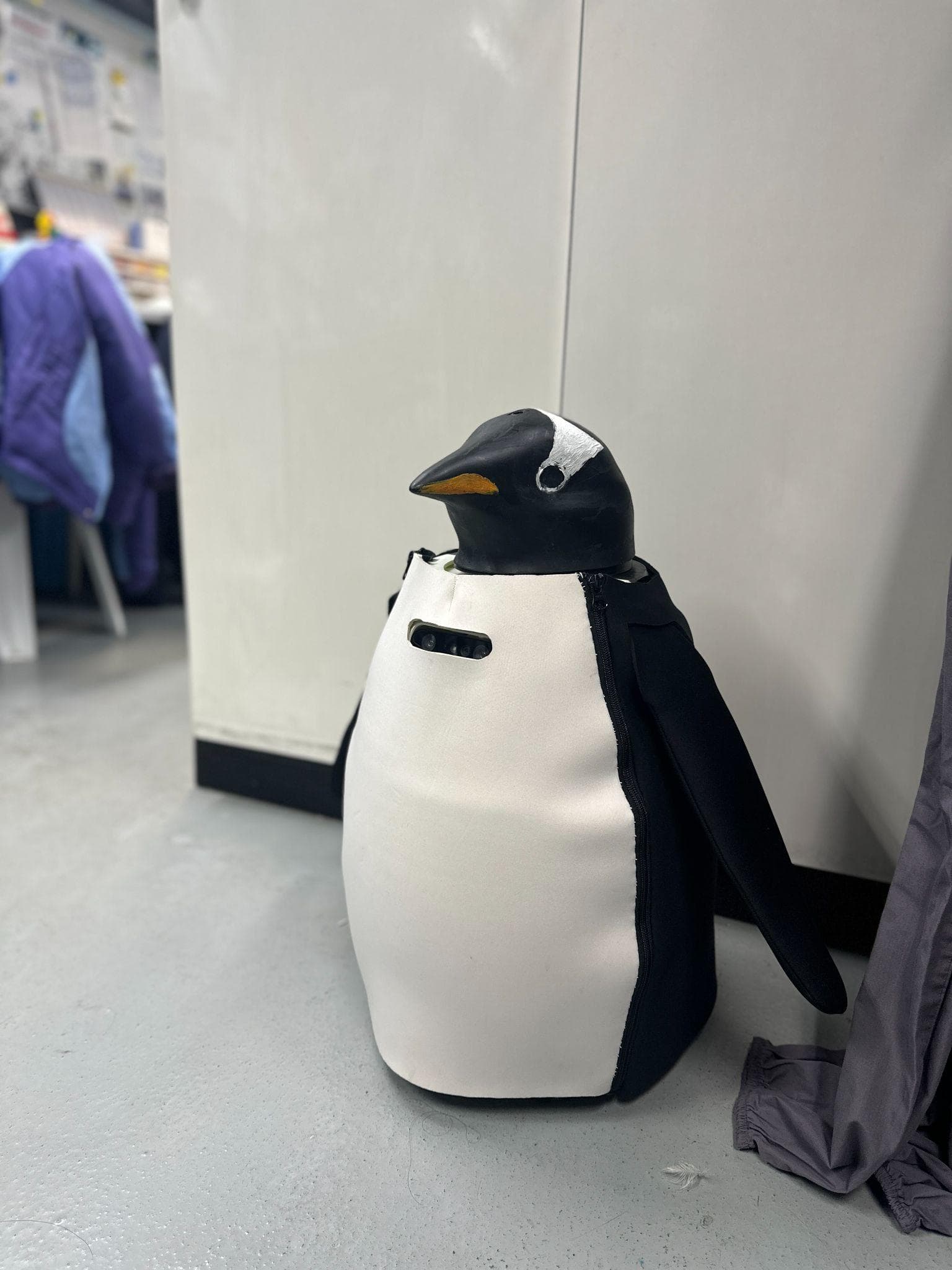
First and most importantly, PANGUAN addresses the risk of direct collision with penguins. PANGUAN is equipped with a stereo camera that provides distance sensing for penguins and surrounding objects, allowing the robot to stop automatically when an obstacle enters a predefined safety distance. The robot is prohibited from moving forward until the obstacle is cleared, maintaining a controlled operating distance from the penguins.
PANGUAN is also designed to reduce and detect the risk of tipping or falling, which could result in collision with nearby penguins. An IMU system monitors changes in the robot's orientation and detects unexpected tilting, enabling fall detection. When the robot exceeds a predefined tilt threshold, a notification is sent to the user, indicating an impending fall or that the robot may have fallen or encountered an unexpected situation. The wheelbase incorporates a suspension system and a low center of gravity to help reduce the risk of tipping. A soft neoprene/SBR outer skin and silicone head provide a softer exterior in the event of physical contact.
Together, these measures are intended to support cautious and controlled operation of the robot around penguins. The field evaluation also provides an opportunity to identify further improvements needed for safe and animal-appropriate deployment.
Bringing the Robot to the Field
To ensure PANGUAN could handle real-world conditions without requiring a human handler right beside it, the current robot incorporated several specialized engineering features:
- Remote web-based control: Allows the robot to be operated smoothly from virtually anywhere with a suitable data connection.
- High-resolution live video streaming: Provides real-time, clear visual feedback directly to animal-care specialists.
- Protective neoprene/SBR outer skin: Shields internal components while offering a soft, protective exterior designed for habitat interaction.
- Basic obstacle detection: Uses a stereo camera for distance sensing to detect nearby penguins or enclosure structures, allowing robot navigation while reducing collision risk.
- Robot fall detection and stability: Uses an IMU to detect changes in orientation and trigger a notification when the robot exceeds a predefined tilt threshold. The wheelbase design keeps the center of gravity low to reduce unexpected tilting.
- Protected internal hardware: Designed to operate reliably in demanding and humid environments.
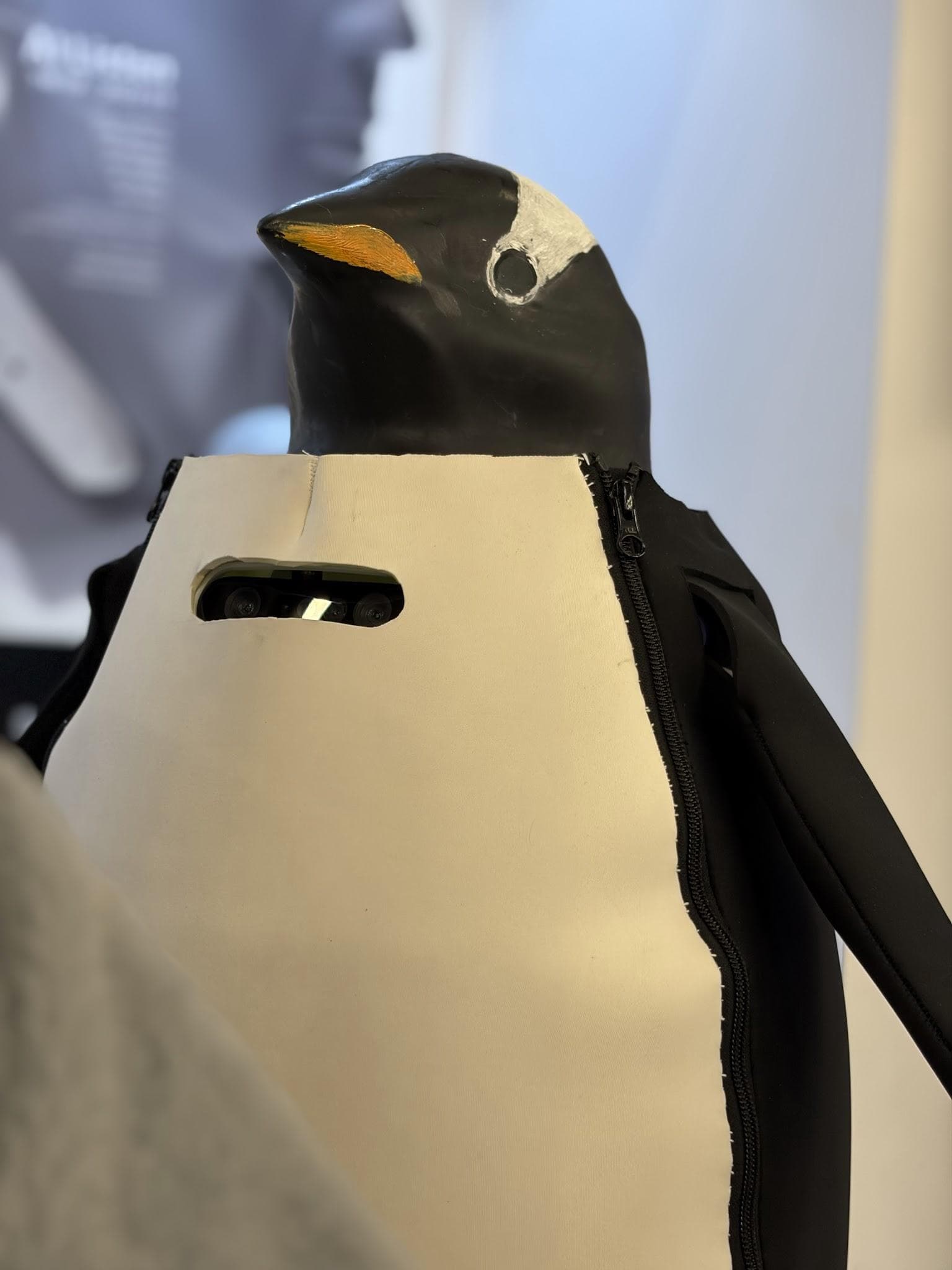
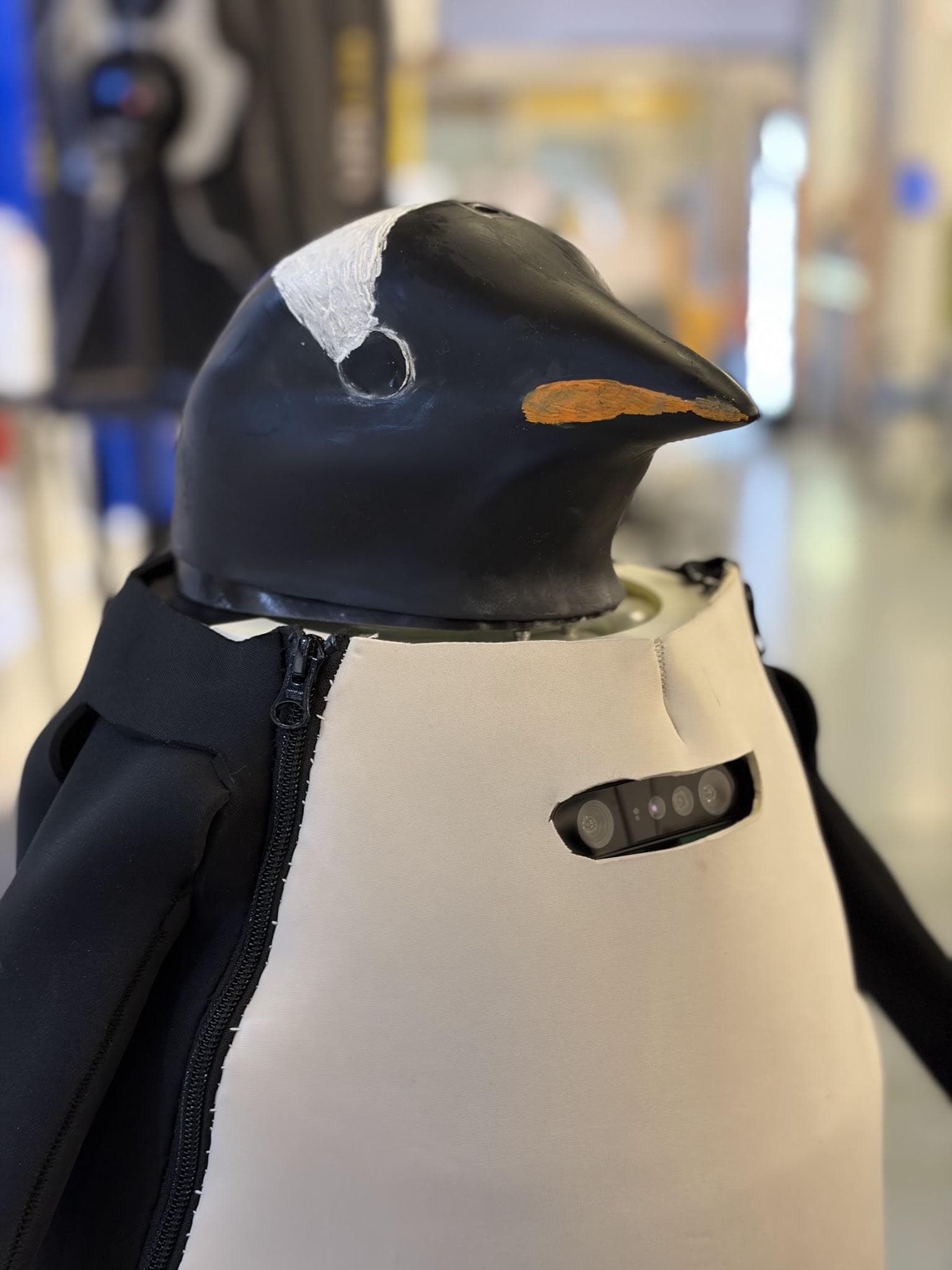
Key takeaway: During the site test, these features allowed PANGUAN to be operated remotely inside the enclosure while maintaining physical separation between operators and the penguins.
Conducting Remote Robotic Operation
The primary milestone of this test was demonstrating the feasibility of remote operation. Instead of placing a person directly inside the habitat, PANGUAN was controlled remotely while streaming live, wide-angle views of the environment.
By removing the human presence from the immediate area, staff can remotely observe animal behaviours, collect visual information, and conduct environmental monitoring. The gathered footage allows close observation of penguins for future research or enrichment.
Learning From the First Encounter
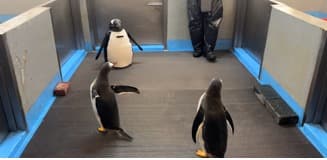
The first interaction also gave us an important lesson. When PANGUAN was initially introduced, all three penguins showed cautious behaviour, including avoidance and wing-shivering. Interestingly, this differed from observations during a visit a year prior, when penguins showed curiosity, including pecking and close inspection, towards a similarly sized penguin robot separated by a film of plastic fence. This highlighted that successful deployment in an animal-care environment requires more than reliable robotics. We also need to understand how animals perceive and respond under different environmental conditions.
For us, this is exactly the purpose of field testing: to uncover challenges that cannot be fully understood in the laboratory and use those findings to build a better robot.
What's Next for PANGUAN?
Our trip to Ocean Park provided invaluable experience that will shape our next iteration. Following the site evaluation, Ocean Park has retained PANGUAN on site, where Ocean Park staff can operate the robot for future evaluation and potential applications.
The field test also highlighted areas for improvement. The current camera angle provides limited visibility of shorter Gentoo penguins at a distance, as well as lower areas such as eggs, while the wheelbase performs best on flat, hard surfaces and may struggle on rougher terrain. Therefore, the robot can currently be used in the backup area for enrichment only. Future iterations will improve camera positioning and develop more terrain-adaptive mobility.
Beyond monitoring, we are exploring how a penguin-shaped robotic platform could eventually provide a form of remote presence or enrichment for animals that are temporarily isolated from their group, such as during rehabilitation or medical care.
Looking ahead, we are exploring future AI-assisted monitoring and enhancing streaming quality, which could empower caretakers with additional tools for animal observation and care. This field experience brings us one step closer to understanding how robotic systems could support animal care in the future.
Stay tuned for more updates on our journey.